Gateway Decisions: How Canadian Businesses Can Gain a Competitive Advantage Through Strategic Port Selection in 2025
The port through which your cargo enters or exits Canada is not merely a logistical detail—it is a strategic decision that affects transit times, freight costs, supply chain resilience, and your company's ability to serve customers across a vast and geographically diverse country. In 2025, Canadian businesses have more gateway options than ever, and the differences between them are consequential.
For importers and exporters engaged in ocean freight, the choice between Vancouver, Montreal, Halifax, and a growing number of inland and regional alternatives involves trade-offs across multiple dimensions: proximity to end markets, available trade lanes, seasonal reliability, intermodal connectivity, and port capacity. This analysis, prepared by Ocean Impex Canada, examines each major gateway and offers a framework for aligning port selection with your organisation's commercial objectives.
The Pacific Gateway: Vancouver and Prince Rupert
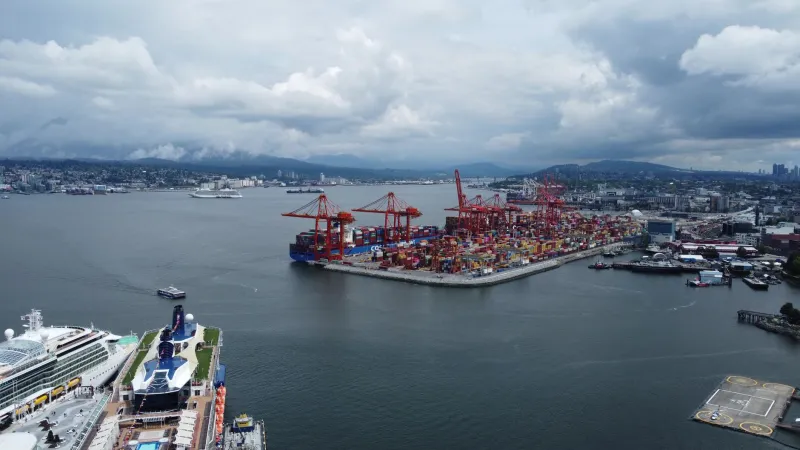
The Port of Vancouver—formally known as the Vancouver Fraser Port Authority—remains Canada's largest and busiest port by tonnage, handling more than 150 million tonnes of cargo annually. Its position on the Pacific Rim makes it the natural entry point for goods originating in Asia, which accounts for the dominant share of Canada's import volume. Shipping lanes connecting Vancouver to ports in China, South Korea, Japan, Vietnam, and India are well-established, with frequent carrier sailings and competitive rates driven by high volume.
For businesses distributing to markets in British Columbia, Alberta, and the broader western interior, Vancouver offers the shortest inland distance from Pacific origin ports. The port's rail connections—served by both Canadian National (CN) and Canadian Pacific Kansas City (CPKC)—provide efficient access to Calgary, Edmonton, and points further east, including intermodal ramps that reach as far as Toronto.
However, Vancouver is not without limitations. Congestion has been a recurring challenge at the port, particularly at Deltaport and Vanterm, where vessel queues during peak periods have extended container dwell times and created downstream delays. The port has invested substantially in capacity expansion, including the Roberts Bank Terminal 2 project, which is expected to add significant container-handling capacity over the coming years. Businesses that experienced disruption during the congestion events of 2021 and 2023 may wish to evaluate whether their supply chains are adequately diversified.
Prince Rupert, located approximately 750 kilometres north of Vancouver, deserves specific mention as a strategic alternative for importers focused on speed-to-market in central Canada. The Fairview Container Terminal at Prince Rupert offers the shortest sailing distance from Northeast Asia to North America and connects directly to CN's mainline rail network. For time-sensitive cargo destined for Toronto or Chicago, Prince Rupert's transit times are competitive with Vancouver's and its congestion profile has historically been more favourable.
The Atlantic Gateway: Halifax and Saint John
The Port of Halifax occupies a distinct strategic position on Canada's East Coast. Its deep-water harbour accommodates the largest container vessels currently in service, and its location on the Atlantic seaboard means it is among the first North American ports of call for vessels arriving from Europe, the Mediterranean, and increasingly, transshipment hubs serving West Africa and South America.
For Canadian importers sourcing from European suppliers—including those in the United Kingdom, Germany, the Netherlands, Italy, and Iberia—Halifax frequently offers shorter transit times and lower port congestion risk than routing cargo through US East Coast ports and then overland into Canada. The port's Halterm and Fairview Cove terminals are connected by rail to CN's network, enabling efficient distribution to Montreal, Toronto, and central Canadian markets.
In 2025, Halifax is also benefiting from increased carrier interest in the Atlantic Canada trade lane, partly driven by shippers seeking alternatives to the congestion and labour uncertainty that has periodically affected US East Coast ports. For businesses that have historically defaulted to routing European imports through New York or Baltimore before trucking into Ontario, a reassessment of Halifax as a direct Canadian entry point may yield meaningful savings in both cost and transit time.
Saint John, New Brunswick, serves as a complementary Atlantic gateway, particularly for bulk and break-bulk cargo, as well as for liquid and dry bulk commodities. While it handles a smaller volume of containerised freight than Halifax, it offers direct access to the Saint John River corridor and is well-positioned for businesses serving the Maritime provinces.
The St. Lawrence and Great Lakes Corridor: Montreal and Inland Ports
The Port of Montreal is Canada's second-largest container port and the dominant gateway for central Canadian trade. Its location on the St. Lawrence River—approximately 1,600 kilometres inland from the Atlantic Ocean—means that vessels calling at Montreal deliver cargo directly to the heart of Canada's most densely populated and economically productive region. For importers and exporters based in Quebec, Ontario, and the broader Great Lakes basin, Montreal eliminates the need for lengthy inland rail or truck movements from coastal ports.
Montreal's strength lies in its direct service connections to European ports, including those in the United Kingdom, Belgium, France, and Scandinavia. The port is also served by multiple carriers offering transatlantic services with competitive transit times. Its intermodal connectivity—via CN and CPKC—extends westward to Toronto, Chicago, and beyond.
One dimension that Canadian businesses should evaluate carefully is the St. Lawrence Seaway's seasonal constraints. The Seaway typically closes for several weeks during winter months—historically from late December through late March—which affects vessel access to Montreal and inland Great Lakes ports. Businesses with year-round import requirements must either build inventory buffers ahead of the closure period or plan for alternative routing through Halifax or US ports during the winter window.
For businesses operating in Ontario's manufacturing corridor or in the automotive and industrial sectors, the Great Lakes ports—including Hamilton, Thunder Bay, and Windsor—offer niche advantages for specific commodity types, particularly bulk materials, steel, and agricultural products. These ports are not primary container gateways, but they serve important roles in specialised supply chains.
Evaluating Port Selection: A Strategic Framework
Choosing the right Canadian gateway requires a structured evaluation across several dimensions.
Origin and trade lane alignment is the foundational consideration. If the majority of your imports originate in Asia, the Pacific gateway is the logical starting point. If your supplier base is predominantly European, the Atlantic corridor warrants priority analysis.
End-market proximity determines inland transportation costs, which frequently exceed the ocean freight component for shipments destined for interior Canada. A business distributing from a warehouse in Mississauga, Ontario, will calculate very different total landed costs depending on whether cargo arrives via Vancouver, Prince Rupert, Halifax, or Montreal.
Service frequency and carrier coverage varies significantly by port. Vancouver and Montreal have the broadest carrier coverage and the highest sailing frequency. Prince Rupert and Halifax offer fewer weekly departures but may provide faster transit times on specific trade lanes.
Resilience and redundancy have become increasingly important considerations following the supply chain disruptions of recent years. Businesses that depend entirely on a single port gateway are exposed to concentration risk. Developing relationships with freight partners capable of routing through multiple gateways provides a meaningful buffer against labour disputes, weather events, and capacity constraints.
Port infrastructure investment signals future capacity and reliability. The Roberts Bank Terminal 2 expansion in Vancouver, ongoing investment at Halifax's Fairview Cove, and the Port of Montreal's Contrecoeur terminal project—expected to add substantial container capacity east of the city—all represent developments that forward-looking supply chain planners should monitor.
Aligning Gateway Strategy with Commercial Objectives
There is no universally optimal Canadian port gateway. The right choice is determined by the intersection of your trade lanes, your customer geography, your freight volume, and your tolerance for transit time variability. What is clear is that the decision deserves deliberate analysis rather than default habit.
Ocean Impex Canada works with B2B clients across a range of industries to evaluate gateway options as part of a broader supply chain strategy. In a competitive environment where landed cost efficiency and delivery reliability are differentiating factors, the port selection decision is one that merits regular review—not a one-time determination made when a business first began importing or exporting.
As Canadian port infrastructure continues to evolve and as global trade patterns shift in response to geopolitical and economic forces, businesses that maintain a dynamic approach to gateway selection will be better positioned to adapt and to compete.