Bridging the Cash Gap: How Canadian Importers and Exporters Are Using Trade Finance to Keep Ocean Freight Moving
For any Canadian business that moves goods by sea, the arithmetic of international trade can be unforgiving. You commit capital the moment you place an order—or earlier, when you open a letter of credit—yet revenue may not materialise until weeks or months after the container leaves port. A transpacific shipment from Shanghai to Vancouver can consume 18 to 22 days in transit alone. Add pre-shipment production time, customs clearance at the Canadian border, and inland delivery to a distribution centre in Calgary or Toronto, and the full cash conversion cycle for a single purchase order can stretch well beyond 90 days.
For mid-market importers and exporters operating on modest credit facilities, that gap is not merely inconvenient—it is a structural constraint on growth. Yet many Canadian firms are discovering that the financial instruments designed specifically for international commerce can do far more than reduce risk. Used intelligently, trade finance tools actively unlock working capital, allowing businesses to take on larger orders, diversify their supplier base, and absorb the cost volatility that has characterised ocean freight markets since 2020.
Why Ocean Freight Timelines Create a Unique Financial Challenge
Domestic commerce operates on relatively compressed payment cycles. A manufacturer supplying a Canadian retailer might extend 30-day terms and expect settlement within the same fiscal quarter. International ocean freight disrupts that rhythm entirely.
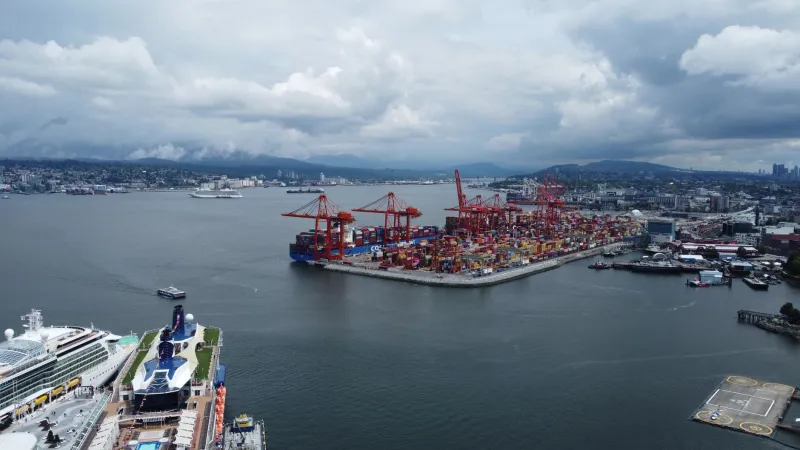
Consider a mid-sized Canadian consumer goods importer sourcing housewares from a factory in Ningbo. The supplier requires a deposit—or full prepayment—before production begins. The importer then waits for production to complete, for the goods to be loaded into a container, and for that container to cross the Pacific. Once the shipment arrives at the Port of Vancouver, it must clear the Canadian Border Services Agency (CBSA), be released from the terminal, and be transported to its final destination. Throughout this entire sequence, the importer's capital is tied up. If the firm sells to Canadian retailers on standard net-30 or net-60 terms, the total exposure period can approach five months.
Multiply that across several concurrent purchase orders, and the working capital requirement becomes substantial—often exceeding what a growing company's operating line of credit can comfortably support.
Letters of Credit: More Than a Risk Mitigation Tool
The letter of credit (LC) is the oldest and most widely recognised instrument in trade finance, and Canadian businesses often treat it primarily as a mechanism for managing counterparty risk. That framing, while accurate, understates its utility.
A documentary LC issued by a Canadian chartered bank guarantees the overseas supplier payment upon presentation of compliant shipping documents. From the supplier's perspective, this eliminates the credit risk of dealing with a foreign buyer. From the Canadian importer's perspective, it provides a structured framework for controlling when funds actually leave the account—payment is triggered by document presentation, not by an informal invoice arrangement.
More sophisticated importers are now using deferred payment LCs, which allow the Canadian buyer to extend the payment obligation by 60, 90, or even 120 days beyond the date of shipment. The overseas supplier receives assurance of payment from the issuing bank; the Canadian buyer gains a meaningful float period during which goods can be received, processed, and sold before the obligation comes due. In effect, the bank's credit substitutes for the importer's own working capital.
Canadian chartered banks—including RBC, TD, and BMO—maintain extensive trade finance desks with experience structuring LCs for ocean freight transactions across Asia, Europe, and Latin America. For businesses that have not yet explored deferred payment structures, an introductory conversation with a trade finance specialist is often a revealing exercise.
Supply Chain Financing: Extending Terms Without Straining Supplier Relationships
Supply chain financing (SCF), sometimes called reverse factoring, has gained significant traction among larger Canadian importers over the past several years. The model works as follows: a buyer arranges a financing programme through a bank or fintech platform, under which approved suppliers can receive early payment—often within days of invoice approval—at a modest discount. The buyer, meanwhile, settles the obligation with the financing institution on extended terms, frequently 90 to 120 days.
The appeal is straightforward. Suppliers, particularly in emerging markets where access to affordable credit is limited, gain immediate liquidity. Canadian buyers extend their payment cycles without imposing financial hardship on their supply chain partners. The financing institution earns a spread. All three parties benefit.
For Canadian importers managing ocean freight logistics, SCF programmes can be structured to align payment obligations with the actual receipt of goods in Canada rather than with the shipment date. This alignment is particularly valuable when dealing with long transit routes—say, from manufacturing hubs in South Asia to eastern Canadian ports via the Suez Canal—where vessel schedules and customs clearance timelines introduce meaningful variability.
Several Canadian fintech firms, alongside the major banks, now offer SCF platforms accessible to mid-market businesses with annual revenues well below the enterprise threshold. The minimum programme size has declined considerably as the technology has matured.
Receivables Factoring: Accelerating the Other End of the Cycle
While LCs and SCF address the payables side of the working capital equation, receivables factoring tackles the other end. Canadian exporters—companies shipping Canadian goods to international buyers—often face the same timing mismatch in reverse. They ship product, absorb the cost of ocean freight, and then wait for overseas customers to pay.
Under a factoring arrangement, the Canadian exporter sells its outstanding receivables to a factoring company at a discount, receiving an immediate advance—typically 70 to 90 per cent of the invoice value—rather than waiting for the customer to pay. When the customer settles, the factor releases the remaining balance minus its fee.
For exporters, this mechanism can be transformative. A British Columbia seafood exporter shipping to European distributors, for example, might ordinarily wait 60 days for payment after delivery. By factoring those receivables, the firm can redeploy capital into the next production and shipping cycle almost immediately, effectively doubling the number of revenue cycles it can complete within a fiscal year.
Export Development Canada (EDC) offers both accounts receivable insurance and direct financing products that complement private-sector factoring arrangements, and their programmes are specifically designed for Canadian exporters navigating international payment risk.
Aligning Finance Strategy with Freight Planning
The most effective Canadian businesses in this space do not treat trade finance and logistics as separate disciplines. They integrate the two. Freight booking decisions—vessel selection, routing, transit time—are made with an awareness of how each option affects the cash conversion cycle. Financial instruments are selected and structured with an understanding of how ocean freight timelines will affect document presentation, payment triggers, and liquidity requirements.
A practical example: a mid-market Ontario industrial equipment importer sourcing from Germany might choose a slightly longer but more predictable routing through Hamburg to Montreal rather than a faster but less reliable transshipment option, specifically because the predictability allows the firm to structure a deferred LC with confidence that documents will be presented on schedule. The logistics decision and the financial decision are inseparable.
Building this kind of integrated fluency—across freight operations, customs processes, and trade finance structures—is increasingly a differentiator for Canadian businesses competing in international markets. Those that treat working capital management as a logistics problem, and freight planning as a financial problem, tend to find solutions that their less integrated competitors miss entirely.
The Path Forward
Canadian importers and exporters operating in ocean freight face a structural challenge that will not disappear as long as goods continue to move by sea. Transit times, port dwell periods, and customs processing cycles are facts of international commerce, not anomalies to be solved. The question is not whether a working capital gap will exist, but how intelligently a business manages it.
Trade finance instruments—letters of credit, supply chain financing, receivables factoring, and the complementary products offered by institutions like EDC—provide a sophisticated toolkit for doing exactly that. For Canadian mid-market firms with the appetite to explore these tools, the conversation begins not with a freight forwarder, but with a trade finance specialist who understands how money moves when goods move by sea.